The buyer list that remembers.
Deal software for corporate finance boutiques
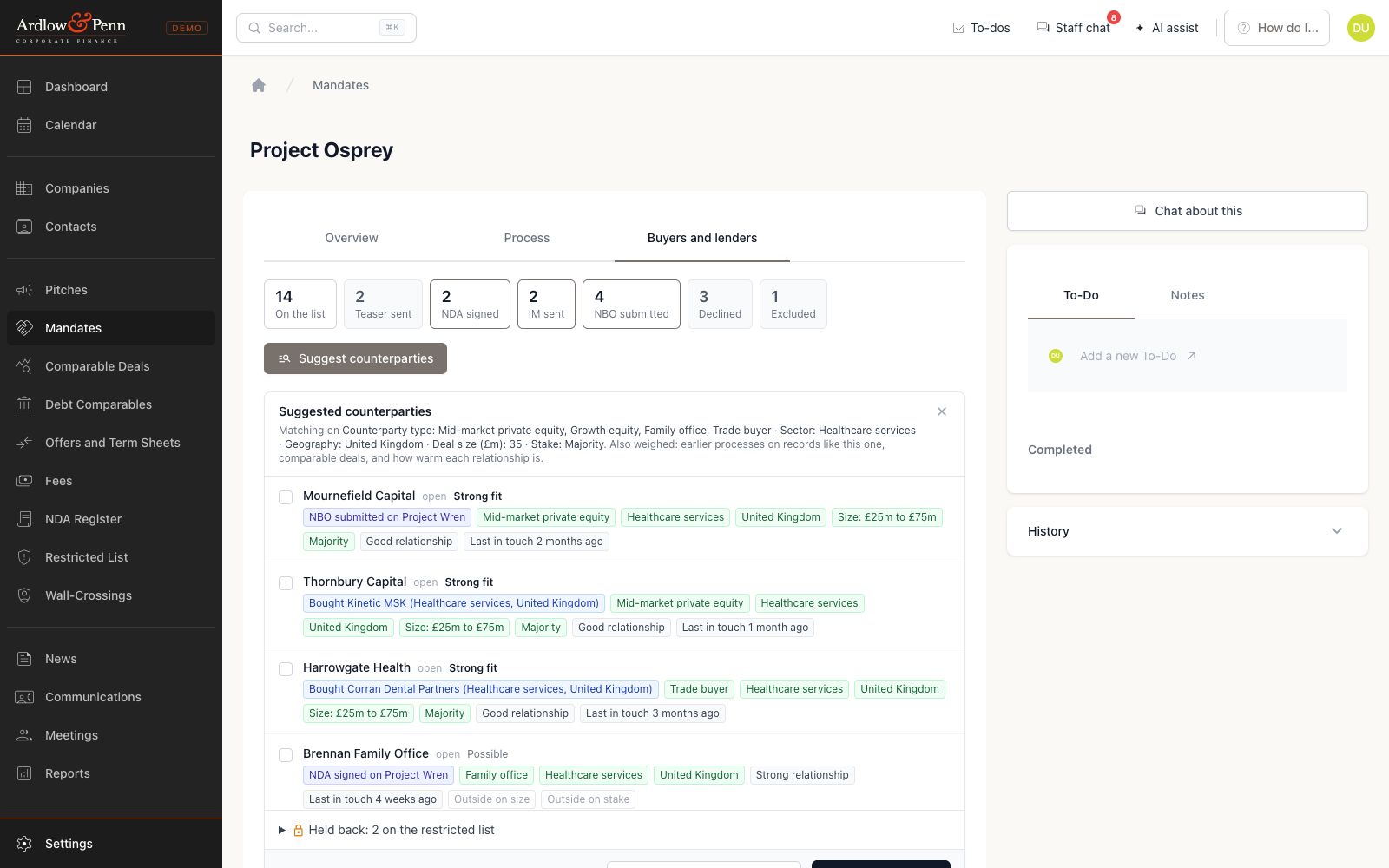
A buyer list that starts from the firm's own history. On any new mandate, ORCA suggests counterparties from what each investor has said it wants, who has bought something similar, and how far each one got on earlier processes. Every suggestion says why.
See how it works

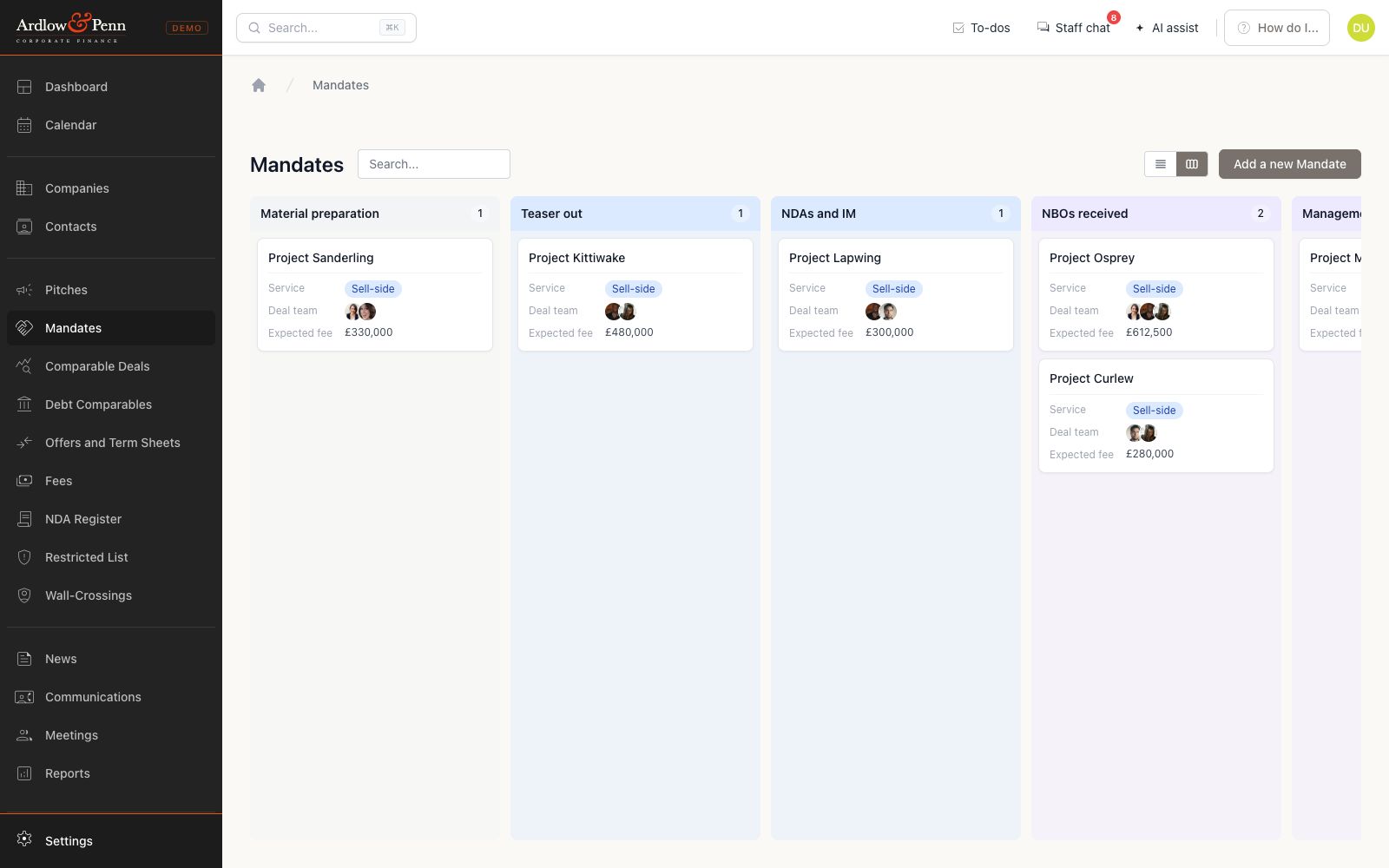
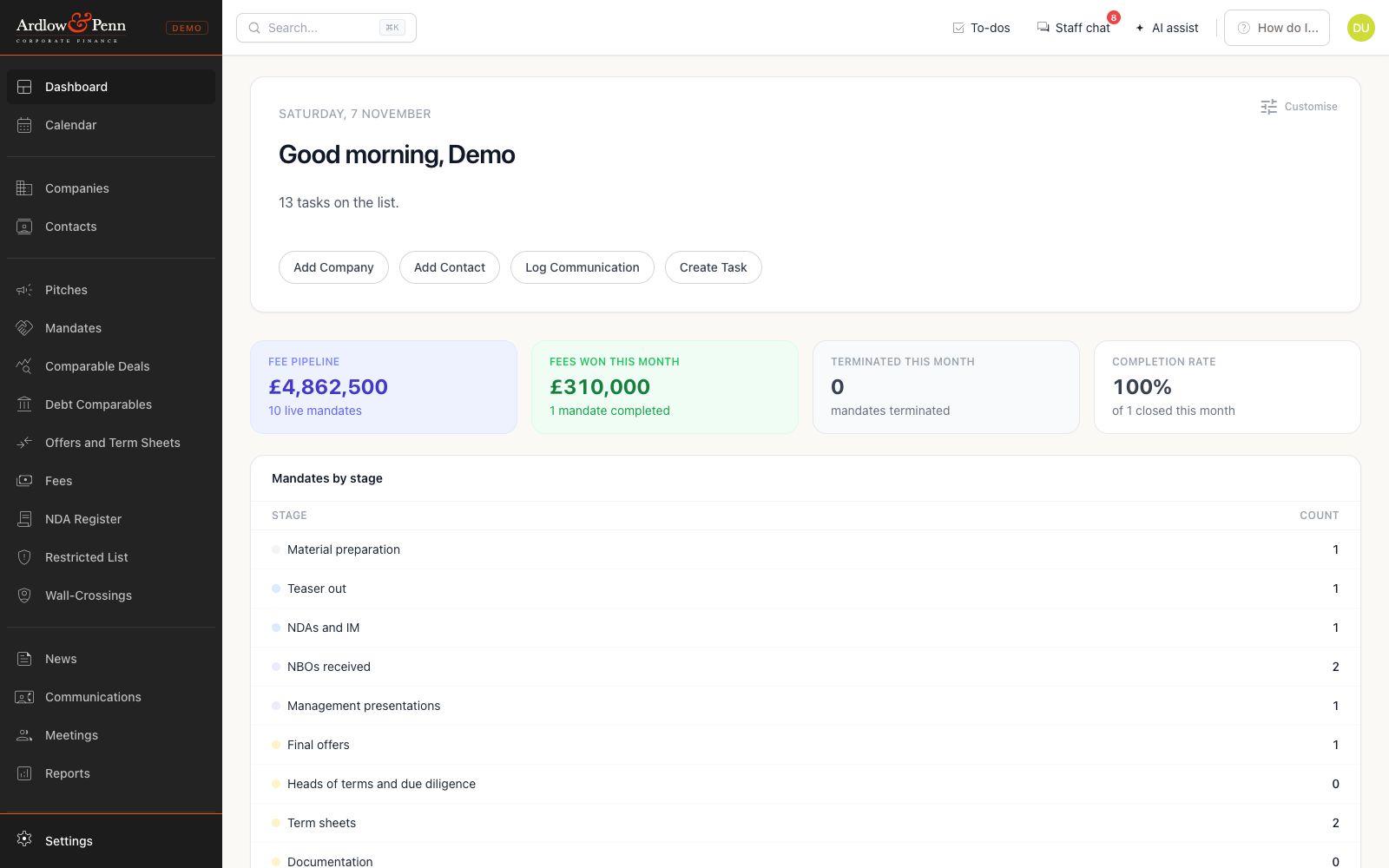
Every live mandate on one screen. Pitches and mandates by code name and stage, from teaser to completion, with the fee pipeline at the top for the Monday meeting.
See the screens

One counterparty, many roles. The same fund can be a client on one deal, a bidder on another and a lender on a third, all on one record.
What's in it

Confidential by default. Restricted names are held back from suggestions, with NDAs, conflicts and wall-crossings on record. Hosted in London, and never used to train AI.
Discretion

Priced by the size of the firm. From £1,200 a month, with everyone included, from the partners to the analysts.
See the pricing

Set up with you. We move your data across and shape ORCA around how the firm works during onboarding. Both are included.
Talk to us

Your data is yours. Export everything from settings whenever you like, without asking. If the firm ever leaves, its data goes with it.
DiscretionOn any mandate, ORCA suggests counterparties using three things only the firm knows: what each investor has said it wants, who has bought something similar, and how far each one got on the firm's earlier processes.
Every suggestion gives its reasons, and restricted names are held back. Tick the ones you want and add them to the list. New names still come from research, but you start from what the firm already knows. A debt raise runs the same way, with lenders on the list.
The reasons come from the firm's own records. ORCA AI plays no part in them.
This example is from Ardlow & Penn, a corporate finance boutique in our demo. The firm and everyone in it are invented, but the software is the real thing. Open the mandate closest to your own work and press Suggest counterparties.
Or see it on your own names. Send us an old buyer list under NDA, anonymised if your own terms need it. We'll load it and show you the suggestions before you commit to anything. Talk to us.
Suggested counterparties
In most corporate finance boutiques, the story of a deal lives in four places: a spreadsheet kept by whoever runs the mandate, an old buyer list on someone's drive, years of email, and whatever was said over lunch and never written down.
Every firm gets companies, contacts, meetings, calendar, tasks and reports, running on its own deal stages.
A typical sale. Each firm uses its own stages, and a debt raise has its own too.
Leads, pitches and mandates in one place. A won pitch becomes a mandate in one click, with its client, team and history. Partners see every live mandate on one screen, by code name.
Each investor's criteria sit on its own record: geography, sector, stake, ticket size and how strong the relationship is. A new buyer list starts from a filter, such as trade and private equity buyers of UK software at £20m to £50m, or majority buyers of healthcare services in the Benelux.
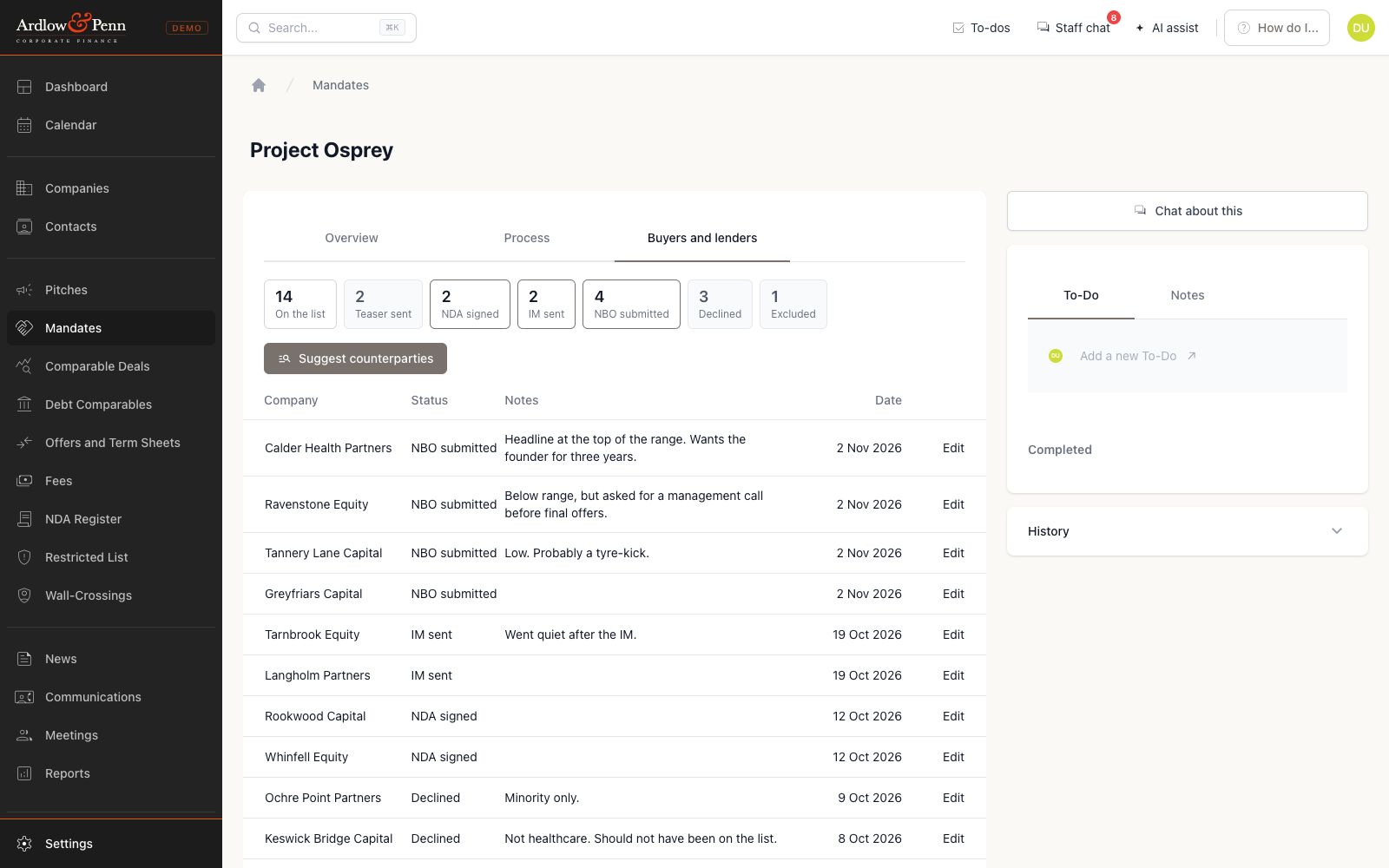
Who was approached, who signed the NDA, who bid and how far they got, kept against the real company. The process runs from the list, so the history builds as the work gets done. On the next mandate, ORCA reads it back as suggestions. Each mandate also prints on one page for the partners' meeting.
A fund can be the client on one deal, a bidder on another and a lender on a third. Meetings record the role each counterparty played, so the history stays clear.
Lenders have their own criteria: products, hold size, margin, tenor, leverage or DSCR, and the assets they'll finance. A refinancing gets its own list and stages, from NDA through credit committee to term sheet, with terms side by side.
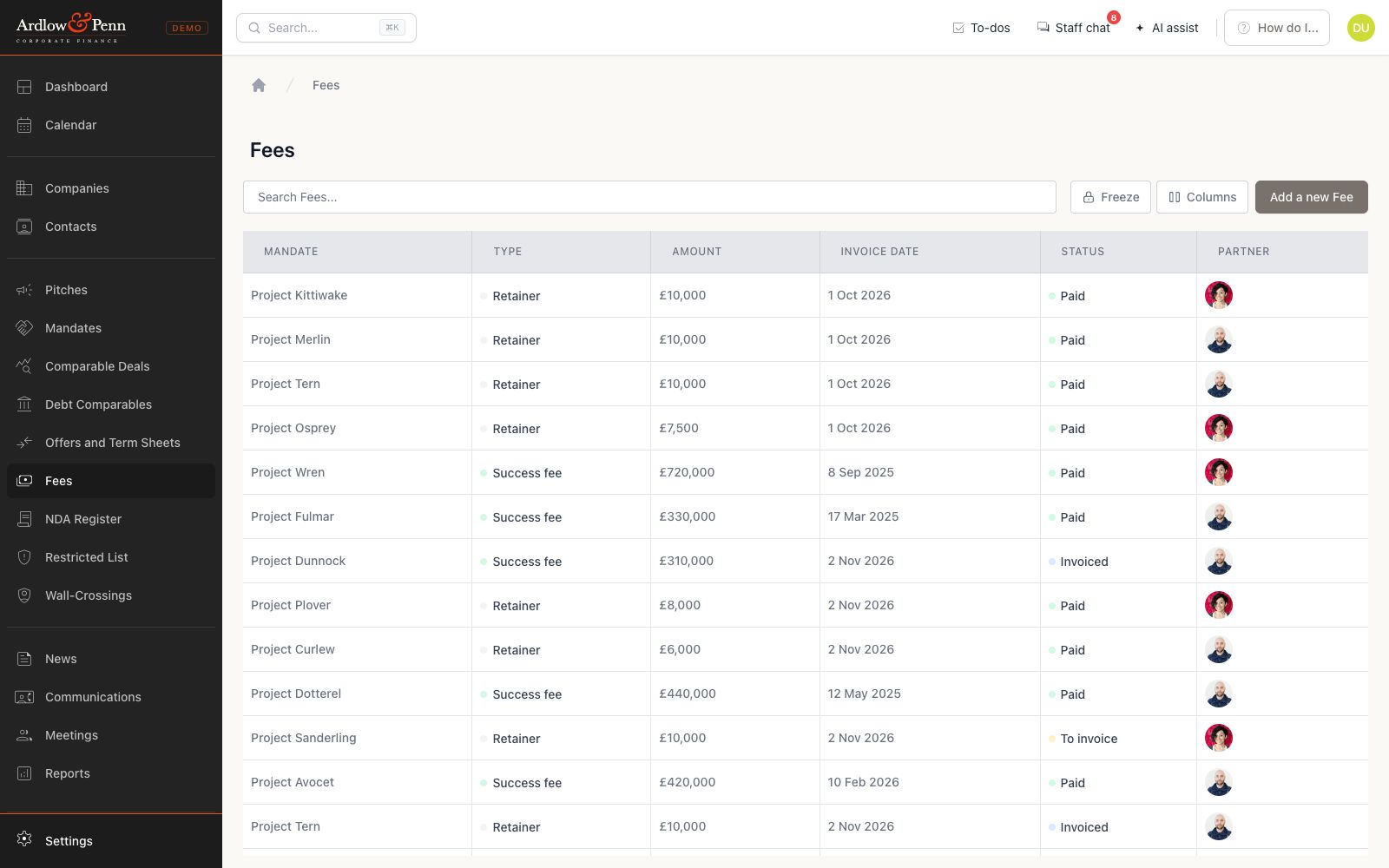
Retainer, success fee and minimum fee on each mandate, a register of what has been invoiced and paid, and the fee pipeline at the top of the partners' dashboard.
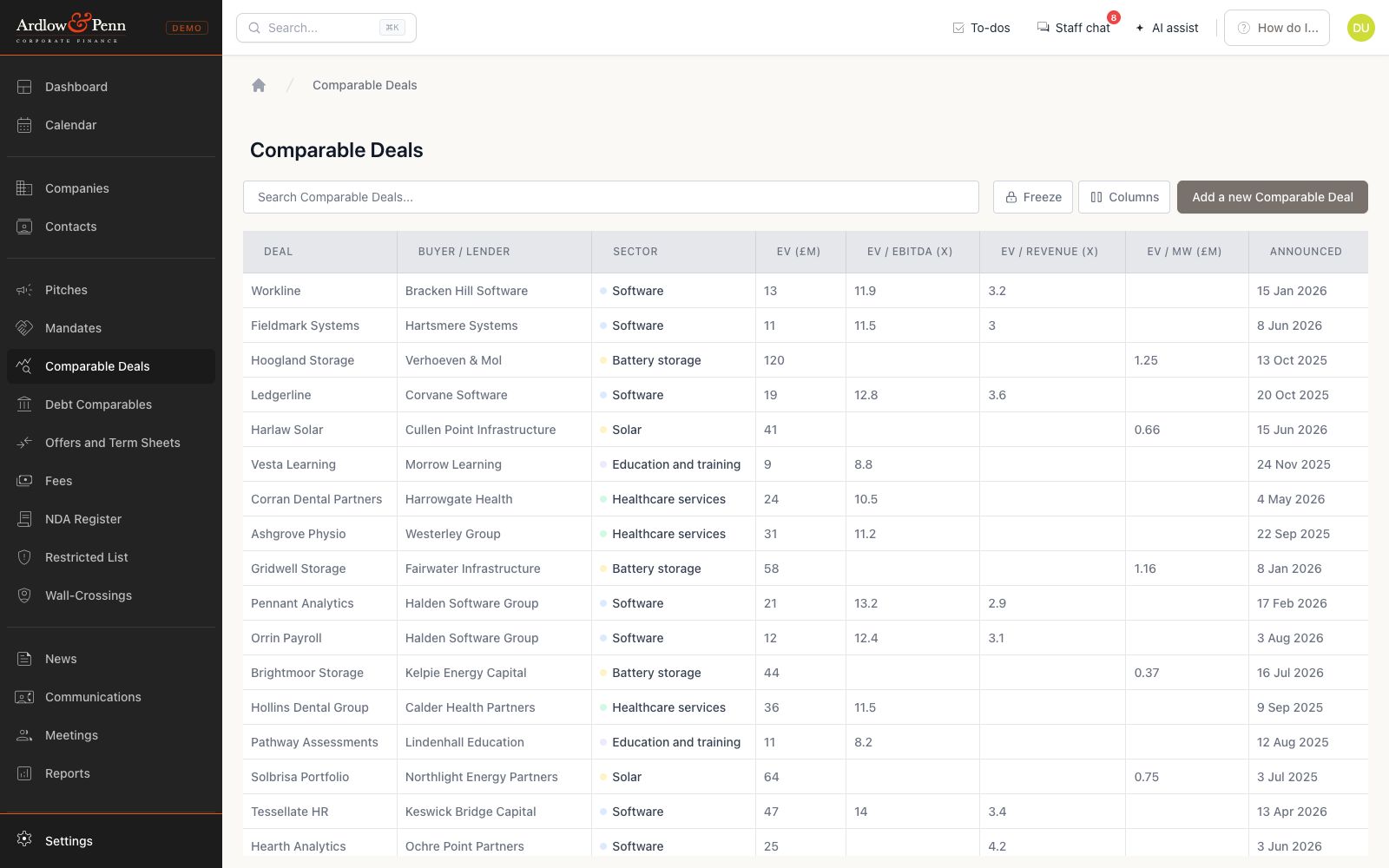
The deals the firm hears about, logged with buyer, seller, sector, size and multiples, in whatever columns you already keep. Anyone who bought something similar comes up on the next buyer list.
Log a meeting once against everyone in the room. Before the next one, ORCA can put together a one-page brief: recent emails and meetings, open to-dos, live deals and any news.
Restricted names, with the date each was added, are held back from every suggested list. Conflict and KYC dates on each mandate, an NDA register and a wall-crossing log, with roles deciding who sees what.
Copy ORCA in on an email from any mail client and it's filed against the right company and contact. Calendars subscribe by feed.
The sources the firm already reads, checked every ten minutes and attached to the companies and people they mention. A morning briefing covers what changed overnight.
Sections, stages and fields follow the firm's own process. We tune them with you during onboarding, whether that's a pipeline shared with a partner firm or earn-out tracking after close.
Every firm, project and person in these screens is invented, and anyone can look round.
Usually under a hundred people, where every deal is different and no one is employed full time to look after the software.
Sell-side and buy-side mandates, pitches, buyer lists and the relationships behind them.
Renewables and infrastructure deals, and the investors and lenders behind them.
Lenders, terms, facilities and the history of who lent on what.
Fund managers and family offices see deals from the other side of the table, so they need a different setup. We're happy to talk it through.
Send us what you have: spreadsheets, old buyer lists, your current CRM. We tidy it and load it.
We set up the stages, fields and lists from how the firm actually works.
Partners and analysts both, using the firm's own deals.
Support and changes come straight from the people who build ORCA.
From your side, it takes a conversation about how the firm runs and time to check what came across. Setup and moving your data are included in the price.
A corporate finance firm's records often include inside information. Here is how ORCA looks after them.
| Size of the firm | A month, plus VAT |
|---|---|
| Up to 10 people | £1,200 |
| 11 to 20 people | £2,250 |
| 21 to 35 people | £3,500 |
| 36 to 60 people | £5,000 |
| 61 to 100 people | £7,000 |
| More than 100 people | From £9,000 |
Everyone in the firm gets an account, from the partners to the analysts. Every module is included at every size, and so are setup and moving your existing data across.
ORCA is flexible, and we'll tune it to how the firm works during onboarding.
Prices exclude VAT. Paid monthly under a written licence. The firm can leave at the end of any month and take its data with it.
Start wherever is most useful: a look at the software, a pilot on one of your closed deals, or a due diligence questionnaire answered in writing. Anything you share is kept confidential, and we're happy to sign an NDA first.
ORCA is based in Glasgow and has been in daily production use for several years. We are a small, founder-led team.
Or email us at hello@orca-crm.com.
We have your note and will reply shortly.